An Incomplete History of Black Skiers

In 1956, Ebony published an article on Bryce Parks and Floyd Cole. Cole and Parks were Black ski patrollers based out of Denver. And they were likely the first African American patrollers in the nation. The reporter wrote that the two skiers were invited in 1952 to “join the patrol by officials who had noted their skill and proficiency,” and that they “were assigned to duty tours with no thought of racial restriction.” Although it did not hint at where or when they learned to ski, the article praised their skill on the slopes. A subtitle noted that they had rescued over 100 people at Winter Park and Berthoud Pass which were the preferred skiing areas of Denverites at the time. The article continued that they were even awarded the Purple Merit Star (Ski Patrol’s highest honor) after saving a skier’s life. Lauding the volunteers’ accomplishments (all patrollers were volunteers in the 1950s), the magazine offered insights from two of the first Black recreational skiers in the nation. The most interesting statement came from Park.  “Amazingly enough,” he said, “there have been no racial incidents. We’ve had cooperation from everyone. Lots of people we rescue are southerners up for a vacation, and they are very cooperative.” It seemed from the article that the ski slopes – some of the whitest places in the country in all meanings of the word – were miraculously free of racism.

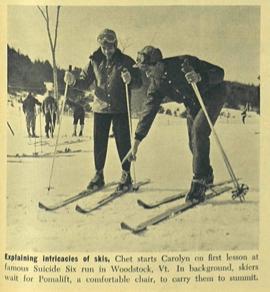
In its early years – the magazine was founded in 1945 – Ebony’s pieces on skiing were generally laudatory. The first article was published in 1949, and it was titled “Skiing: Popular Winter Sport Becoming Favorite with Negro Fans.” According to the magazine, skiing which was rapidly growing in popularity nationwide, was also increasingly appealing to America’s Black middle class. About a decade later, in 1958, Ebony published a laudatory piece celebrating Chet McGuir, a Black skier at Dartmouth. Noting McGuir’s place in one of America’s most exclusive institutions, the article recounted the invitation he extended to Carolyn Morant, a Black student at the equally prestigious Bryn Mawr College outside Philadelphia. Despite only being students, the article was filled with pictures. One depicted McGuir teaching Morant to ski on Suicide Six, in Woodstock, Vermont. To the knowledgeable skier, the implication was clear. Suicide Six was the location of the United States’ first rope tow in the mid-1930s (although it is far to wonder how many readers at the time had a sense of ski history). Iconic and prestigious, the implication was if Black skiers could ski there, why not anywhere? The magazines general reflections on skiing continued. An article in 1960 celebrated Dave Lucy, a Black student from North Conway, New Hampshire. Lucy had formerly skied on the Denver University race team. Furthermore, his hometown of Cranmore, New Hampshire where one of the first ski hills in American was located, enhanced his bona fides as a skilled skier. These first several articles were almost formulaic. They highlighted young Black skiers. They celebrated the sport as increasingly popular to the Black middle class. And, almost universally, the subjects had ties to iconic ski locations, Denver University and North Conway, Berthoud Pass and Winter Park, and Dartmouth and Suicide Six.
Ebony averaged about one article every two years (or every other winter edition) on skiing from its founding in 1945 through 2000. (In comparison, golf was mentioned once every 1.6 years, tennis every third issue, while football and basketball were mentioned multiple times an issue on average.) While skiing certainly did not dominate the magazine, an article every eighth edition does demonstrate some level of consistent interest in the sport by the publication’s journalists and by their readers, for a sport that is mostly white.  Like many of Ebony’s articles, their pieces on skiing were mostly positive. While focused on Black culture and politics, the magazine unabashedly sought out “the zesty side of life.”  Ebony was founded on the premise that “not enough is said about all the swell things we Negroes can do and will accomplish. Ebony will try to mirror the happier side of Negro life – the positive, everyday achievements from Harlem to Hollywood.” The more exclusive aspects of skiing, expensive lodges and cottages, beautiful mountains, and isolated locations, all gave skiing the glamour that Ebony sought to share, while simultaneously demonstrating barriers that were being broken.

Early on, the magazine celebrated individual Black skiers. But as time went on, they also began writing about Black ski clubs. The first article to investigate a group of skiers was a 1962 piece on the Jim Dandy Ski Club of Detroit. Founded in 1958, they were the first Black ski organization in the United States. And though unstated in the article, the organization offered safety in numbers for Black enthusiasts who were passively or explicitly unwelcome at many resorts. This focus continued into the 1970s, as the National Brotherhood of Skiers (NBS), a national organization for Black enthusiasts, began to gain prominence (both in Ebony and nationwide, in a country that had largely come to think of explicit segregation in negative terms).

Park’s 1956 claim that he experienced “no racial incidents” was frequently repeated, although in different words. It became the calling card of ski articles in the magazine. Despite people’s perceptions, and despite skiing’s reputation, overt racism was largely absent on the slopes – at least as far as the journalists and those interviewed were concerned. The party line of Black skiers embraced what Ibram Kendi, in his book Stamped from the Beginning, calls an assimilationist logic. Rather than embrace a philosophy that skiing must change to offer equitable access to ski resorts, ski equipment, and instruction, most of the Black skiers interviewed (although not all) highlighted how easy it was to melt into the Eurocentric ski world. For instance, in an article in 1974, Ebony estimated that there were between 15,000 and 60,000 Black skiers in the United States (which is to say, they had no idea how many Black skiers were in the States). Importantly, the article quotes Art Clay, one of the founders of the NBS. He said, “as more blacks have become middle class, they have found that they have more time and money to spend on leisure interests. In his own words, ‘you don’t want to sit around all winter just because it’s cold outside.’” As he suggested, middle-class Black people understandably wanted to partake in the same type of recreation and vacations as the white professionals they increasingly interacted with.

Economic prejudice became the party line of the NBS and of Black skiers more broadly – at least those interviewed. But threats of violence, explicit exclusion, and overt racism quietly emerged in Ebony and other news sources. In the early years, like in all aspects of tourism, Black skiers (like Jewish skiers) found that many hotels and resorts were “restricted.” For instance, in a 1949 survey conducted by the magazine, of 116 resorts surveyed about whether Black skiers were welcome, 90 responded: 32 qualified acceptance, 35 rejected Black skiers, 4 didn’t know, 8 claimed they were closed or closing, 4 said they had no overnight facilities, 7 gave general info, 3 said yes “but were filled”, 6 said “Filled now, try later.” This type of information was quite normal for Ebony at the time. As Carolyn Finney has written in her canonical book Black Faces, White Spaces: Reimagining the Relationship of African Americans to the Great Outdoors, one of the magazine’s essential functions was informing Black Americans about where they could safely travel and recreate. But as journalists continued to write about Black skiers, explicit statements about racism were sometimes more difficult to parse.
Clay and many others in the NBS contended that Black exclusion from skiing was the result of class dynamics more than racial dynamics. Ben Finley, another founder, frequently mirrored this sentiment in interviews, highlighting what he saw as a type of economic exclusion. For instance, the following year, Finley was quoted in The Independent, a paper in Long Beach, California. In the interview he suggested that “the sport is prejudiced – but not in the traditional sense.” Finley said, “It’s an economic prejudice… Anyone on the lower level is excluded from skiing because of the expenditure necessary to participate.’” As a result, the issue was not ski culture or the ski industry; rather, the primary enemy was Black poverty. However, not everything was about economics. Finley, Clay, and many others also highlighted the importance of representation. They pushed for more ads with Black people skiing (which Ebony began publishing in later years). And the NBS’ stated mission was (and is) to help find and fund the first Black Olympic skier. Nevertheless, at its root, they argued that the reason more African Americans did not ski was due to the economic realities of American life, which was built on a foundation of inequality, rather than the types of vacations ski resorts sold.

Often, in Ebony, comments on racism in skiing were disguised or hidden but would have been understood by careful readers of the magazine. For example, in a 1965, an article placed a quote by Kert Samples, an instructor in France, at the end of an otherwise benign image. Samples insisted that racism had hampered his career as a skier in the United States. He said, “otherwise I wouldn’t be here.” Yet, the photo, far from depicting Samples’ resentment, focused almost exclusively on the glamour of skiing in France. In another instance, an article focused on Dick Martin, who owned Four Seasons Ski Shop in New York, and ran a successful ski club. The second paragraph in the article begins by stating that “Martin claims his skiers have never run into racial troubles.” Yet the article continues, noting that one skier in the club had “overheard a white skier quip to another: ‘I don’t see any cotton fields around here.’” The statement by the white skier may have been intended to be a harsh “joke.” But we also know jokes of the kind usually come with a specific intent: to convey messages about white supremacy. So, despite Martin’s claim, the lack of “trouble” was likely due to Black skiers avoiding confrontation as much or more than the fact that they were welcome on the slopes. As Black scholars have pointed out, and as many Black people know from personal experience, explicit threats are not necessarily needed to convey a danger. And these types of “jokes” were likely common (and likely are still common) on ski slopes throughout the country. According to Black skiers like the current NBS head Henri Rivers, such forms of not so subtle racism continue. In a recent interview, he noted that despite his qualifications (and unstated his position as the head of the single largest ski club in the nation), he has frequently been passed over when it comes to teaching the highest level racers at his home mountain. He also recounted that even now, he will get “looks” and that “people will say to him ‘I didn’t know Black people ski.” Though the press and Black skiers tend to highlight the ways in which economics restrict people from skiing, reading closely reveals what Anthony Kwame Harrison calls “the everyday racism” inherent in skiing. In skiing’s history, both overt and veiled acts have worked in conjunction with economics to make skiing seem unappealing even to upper-middle-class Black communities who can afford to partake in the exclusive winter sport.

A broader history of Black skiing has not been told to its full extent. Most articles begin the history in the 1970s, with the story of the NBS. Such histories are usually based on interviews with the founders of the National Black Brotherhood, an organization that (fairly enough) tells an intentional and welcoming story of skiing’s past. Interviewing the same people who were interviewed by journalists in the 1970s has resulted in articles that tend to recount a now well practiced story of the organization. Journalistic attention has emerged historically in clusters and in moments in which America was especially focused on racial conflict. For instance, the National Brotherhood of Skiers emerged – and received an outpouring of press – during the Black Power movement. Once again, after the Rodney King beating and riots in the early 1990s, press interest in Black skiing rose once again. And, in the past few years, the rise of Black Lives Matter and the protests over the summer of 2020 initiated a third wave of press attention and discussions of diversity and inclusion in the ski industry. (Since I wrote this article as the Derek Chauvin verdict was being released, it can be assumed that this post fits well within the trend.)

Black skiing deserves a more extensive history. Rather than remarking on the absence of Black bodies in the sport, such a story could focus on the difficulty African Americans had in taking part in it. An in-depth study of historical articles, and the usage of a diverse set of oral histories may reveal elements of the past that do not fit into the clean and well-practiced narratives of the Black skiers who make up the majority of interviews. By diversifying the stories told, and depicting a broader history of Black skiers, it may become possible to demonstrate to the ski industry and ski culture at large that economic investments in Black skiers are not enough. The ski industry and skiers more broadly need to change if the sport is to become genuinely diverse, inclusive, and equitable.
Architectural Meaning at Arizona Snowbowl – Lesson Plan

Building Natures

Level: Undergraduate (less than 100 students). U.S. History, Environmental U.S. History, Environmental History, Histories of National Lands, History of Architecture.

Necessary Material:  Computer and projector set up with power-point or equivalent and enough printed versions of each image for each group.

Overview: This lesson is about reading through images the different ways in which architecture and landscape design mediate how people engage environments.

Objectives:

Identify: Which parts of buildings and landscape changes may relate to the environment.

Analyze: How these pictures demonstrate change over time.

Understand: That through architecture and landscape design the meaning of people’s relationships with nature change over time, even if the location and purpose of those infrastructures on surface-level seem consistent.

Gain: the ability to critically analyze how material changes affect meaning over time.

Historical Context: Arizona Snowbowl is a small resort built above Flagstaff, Arizona. Despite its small size, it was opened in 1938, making it one of the oldest ski resorts in the country. Alpine skiing can be understood as going through changes. In large part, these were driven by a growing middle class following World War II and by changes in technology, including better equipment, better lift technology, and snowmaking.

Document Analysis:  

1) Split the class into groups of three. Give each group one image and instruct them to analyze what materials and design factors may affect the relationship between the environment and the building/skiing for the skier. (Warning: the trail map will almost definitely prove the most difficult to analyze.) Give the groups roughly five minutes to work through these images. Make sure to offer guidance as to think about the relationship between building, landscape, and architecture. It may be helpful to offer thoughts to begin with, or even to have them read the accompanying article and then expand on it.

2) Break up the existing groups and form new groups so that each group has one person from the previous groups. Ask these new groups to us the discussion from the previous groups to analyze how the images collectively demonstrate change over time. In other words, how did architecture and landscape change peoples relationship to the same place over time? If previous classes have prepared them, they can also be asked as a secondary question how these changes may (may or may not) relate to larger changes in relevant histories.

3) Debrief. Bring the class back together and work through each stage of this together to make sure students understand broadly. Inevitably some groups will be more successful than others in the endeavor.  

Potential Class Discussion Questions:

First Grouping:

What does your image show? What are hints at the time-period of the image?

What in it is built and what is natural? What parts of the structure and/or landscape work with the environment (or remind people of the natural environment) and which work against it? Could it be interpreted either way/

Think about how these landscapes and architecture mediate people’s relationship to the environment. In other words, how do the structures help or make people engage with the environment?

Second Grouping:

What is different in what is built and what is unbuilt in each image? Do the images highlight different parts of the built and unbuilt environments?

How do these changes affect how people likely related to these mixed spaces?

If you were to tell a history of resort architecture based on these pictures, how would you describe the trend from the first image to the last?

Architectural Meaning at Arizona Snowbowl

In 1938, in the densely wooded forests of the Coconino National Forest, the Flagstaff, Arizona ski team opened a ski area at the base of Humphrey Peak. Cut into the middle of a mixed Birch-Pine forest, the ski hill, at the time, may have been the southernmost ski area in the country. And it marked an early point in the surprisingly strong ski culture that has emerged in the arid southwest. Humphrey Peak’s prodigious winter weather was only possible due to its towering height of 12,637 feet. Nevertheless, much like other ski hills of the time, Arizona Snowbowl remained little more than a lodge and rope tow until after World War II. But, in the early years, it did its job – allowing for the ski team to train, and for a few local enthusiasts to indoctrinate themselves into the still-new sport of Alpine skiing.

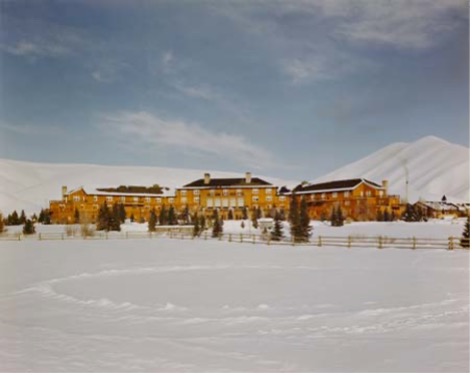
A view of Sun Valley Lodge. Image from the Ketchum Public Library.

Two years earlier, in 1936, the first large-scale American resort opened in Sun Valley, Idaho. Sun Valley is one (of a few) origin stories for the American ski industry. Architectural historian Margaret Smith has written that despite being buried deep in Idaho’s wilderness “urbanity…exuded” from the resort. The Lodge at Sun Valley was luxurious. In a Union Pacific Railroad brochure, the new ski resort was described as a place where “civilization outposts meet a vast wilderness of mountain, forests, lakes, and streams,” continuing that the ski area had “the most modern and luxurious accommodations possible.” Costing $1.5 million, the lodge had over 200 rooms, and an entire wing dedicated to entertainment, public dining-rooms, and even shopping. Furthermore, the owner stuffed the lodge with New York City’s and Hollywood’s richest and famous, adding a cultural cache to the resort from the get-go. The building and the resort, in turn, eschewed the traditional western motifs of most resort architecture in the Rocky Mountains and the Sierra Nevadas, which tended to highlight natural opulence.Interestingly, the chief architect Gilbert Stanley Underwood had spent the previous years building lodges, such as the rustic Ahwahnee Hotel at Yosemite for the National Park Service. As a result, Sun Valley proved to be an about-turn for the architect most well-known for building with the surrounding environments rather than in contrast to them.

Photo of Averell Harriman in 1965. Image from Wikicommons.

Sun Valley was financed and owned by railroad tycoon and politician Averell Harriman. Harriman not only had a special vision, he had the monetary means to create it. However, for the ski team in the small city of Flagstaff, building a high-end modern resort was not an option. Although no records specify how the decision was made, images suggest that the first lodge was influenced by the stylistic standards of the National Park Service and the Civilian Conservation Corps. The National Park Service, which was inaugurated in 1916, had guidelines dictating that buildings should be “rustic structures” that use local stone and wood, along with minimal ornamentation, to blend with their natural surroundings. Although few ski hills were on National Park Lands — more commonly slopes were cut in national and state forests — at least for the time, the rustic park-style proved more popular than Sun Valley’s modernism. Perhaps the two most famous of these are the small warming hut at Mount Mansfield (now Stowe, Vermont) and the iconic Timberline Lodge (on Mount Hood in Oregon).

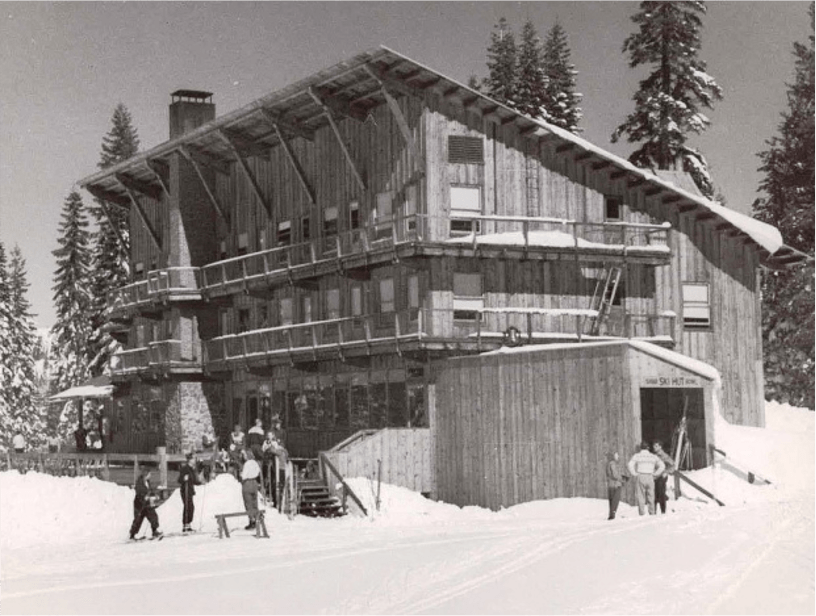
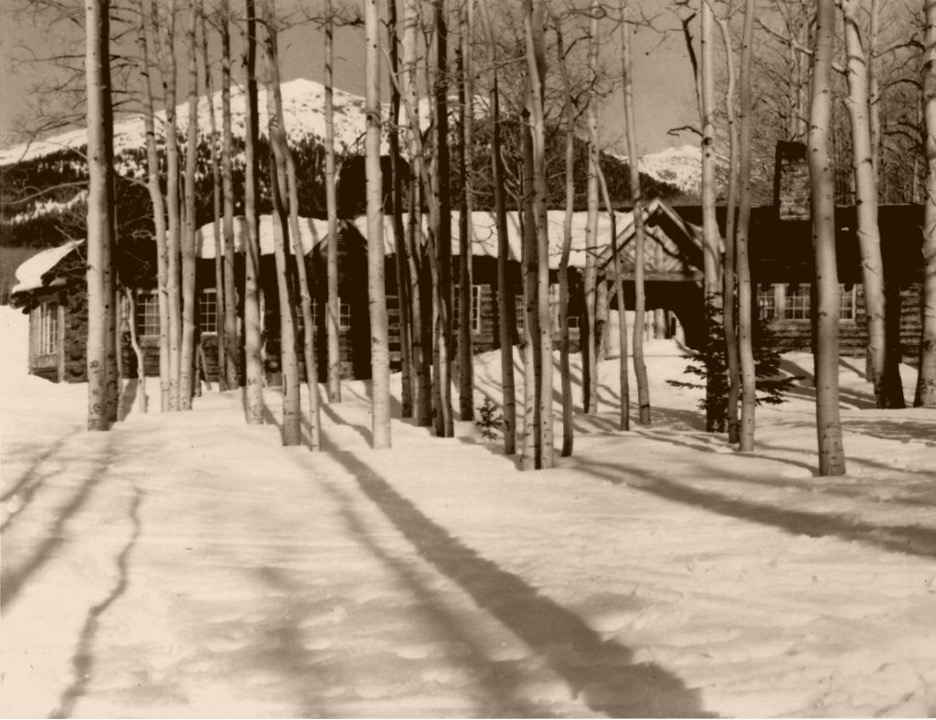
The first lodge at Snowbowl was quite basic. Built within a grove of birch trees, the rustic log-cabin lodge fit seamlessly into the mountain-scape. For skiing, log cabins took on a double meaning. The design mimicked an idealized version of an American settler building a simple homestead in the hills. The image of the log cabin was a clear and readable symbol in American culture. The homage to the frontier would have been unmissable. However, log cabins are also a deep and persistent part of Scandinavian architecture. Skiing’s roots are in Scandinavian – and particularly Norwegian – culture, but the log cabin also likely derived from Swedish settlers in the 17th century. In a region with little Scandinavian immigration, it is not clear if Snowbowl was tied directly to the Norwegian tradition of skiing. Nevertheless, names such as Alf Engen (Alta) and Carl Howelsen (Steamboat Springs) — among many others — were already nationally famous for their role in bringing skiing to the United States. As a result, the American frontier and the Scandinavian ski cabin merged to call back to two geographically distinct histories. The large-scale modern lodge at Sun Valley brought to mind the idea of the increasingly modern and exclusive Alps. In contrast, smaller rustic lodges like Snowbowl’s (intentionally or unintentionally) pulled skiers minds back to an imagined history that conglomerated the sport’s national origin in Norway with America’s historical process of imperial expansion.

The original lodge at Snowbowl. Image from Snowbowl website.

By the early 1940s, with World War II in full swing, Snowbowl all but shut down.  In 1946, California businessman Al Grossmoen bought the ski area. He expanded the resort to include multiple rope tows and Poma-lifts. But he also chose to replace the cabin with a new lodge. The new Agassiz Lodge, like the first, was not built by a professional architect. Grossmoen, who designed it himself, likely brought ideas about ski architecture from California, where he had previously lived, to Arizona. Although a much smaller scale, the new lodge at Snowbowl was reminiscent of the larger base lodge built by William Wurster at Sugar Bowl in California, around Lake Tahoe.  According to Smith, Sugar Bowl’s lodge was a “modern ‘ski shack’ evocative of vernacular mining structures in the region.”9 Built with a sturdy slanted roof, the Agassiz Lodge was, like the lodge at Sugar Bowl, built so that heavy snowfalls could slide off the back of the building. This design had two benefits. First, it created a dramatically large and unshaded window out of which people in the lodge could watch the slopes while warming up and eating lunch. Second, by pushing snow to only one side of the building, the roof protected the deck from roof-avalanches. This both saved ski-area staff from shoveling extra snow off the deck, while also protecting guests from potentially deadly snow slides — although deaths from roof-avalanches are exceptionally rare. The openness of the lodge to the ski slopes, along with the relatively closed-off nature of the road-facing side of the building, meant that unlike the original lodge, which pulled people equally into the slopes and the forest, this pulled the slopes into the building, allowing spectators in the lodge to in a sense take part in skiing.

In addition to referencing California mining culture, the lodge also used subtle ornamentation to tie the building to other ski styles. For instance, the exposed timbered cross-beams visible under the roof harkened back to the rustic appeal of the older lodge. Meanwhile the white balusters on a brown building inverted a traditional Tyrolean color palate, hinting at Alpine skiing’s heritage in Tyrol — a move that intentionally or unintentionally revealed the increased understanding of Nordic and Alpine skiing as distinct sports. As a result, the lodges spoke to a number of different themes. It spoke to California mining history, the appeal of European ski culture, and the desire of people to watch people on the slopes. However, at the same time, the lodge itself was increasingly divorced from the environment around it. Making its conglomeration of styles somewhat out of place in northern Arizona.

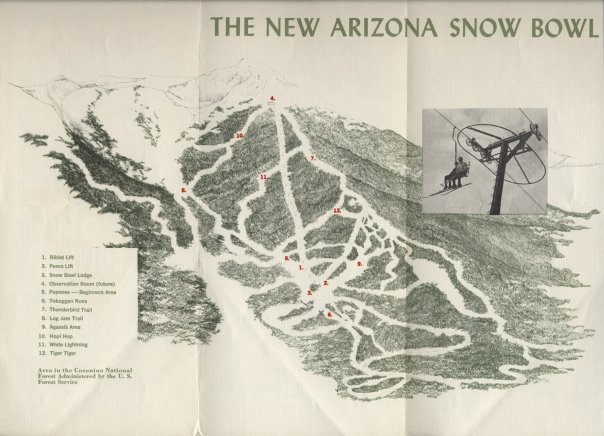
While the lodge continued to be updated periodically, infrastructural improvements were more often functional in intention, than they were aesthetic. Nevertheless, these changes provided new meanings to both the building and slopes. For instance, while more famous resorts such as Sun Valley, Alta, Vail, and Mt. Mansfield (now Stowe) all boasted chairlifts as early as 1950, Snowbowl waited until 1960 to purchase their first.The chairlift, as well as the early ground lifts changed how quickly people could move up the slope, they also changed the mountain as ski-scape. The ski hill can be better understood if split into three imperfect parts – the bowl, the ridgeline, and the fall line. The natural bowl at the top funnels down into Logjam Trail (#8). Although Logjam is marked as a trail, it is unlikely that the space below the bowl was cut. Rather, Logjam may have been the natural runout of avalanches . The bowl, due to its steepness, has a number of avalanche paths. The dramatic force of the snow sliding down the mountain would have naturally prevented tree growth in the area. Part two is Thunderbird Trail (#7). This ridgeline was cut to allow skiers to traverse the ridge providing multiple paths into the gully. While ridgeline runs are not uncommon at ski areas, it is seems that Thunderbird was cut to give increased access to the mountain by working with its natural landscape. Finally, there are the various cut runs, zigzagging down towards the gully. (The gully itself acted as a funnel to bring skiers back to the base lodge where the lifts were located.)

The chairlift can be faintly seen on this 1960 trail map as a grey line running from #3 to #4. It is technically #1 according to the key. The Poma Lift is marked as #2. Original image from skimp.org.

Ski maps, rather than showing the topography of the mountain, are intended to make runs easier to follow. So, it is difficult to know precisely why runs where cut how they were. But the earliest runs were likely cut narrow and intentionally curving to provide a uniqueness to each trail. (This was later changed on many mountains throughout the country to better accommodate grooming and snowmaking pipelines.) In contrast to these runs, the Agassiz Double Chair (later replaced by a triple chair and then a gondola) cut a new type of line through the mountain. Pomalifts and rope tows worked best when facing directly up a fall line. In contrast, the chairlift was designed to find the most direct route to the top of the trail, cutting a diagonal path across slopes otherwise curated to maximize the natural contours of the mountains. The newness of this can be seen by how the lift cuts across several pre-existing slopes.

The addition of the chairlift in 1960, along with a second in 1988, not only changed the relatively natural landscape of the mountain, it also changed the relationship between the lodge and the slopes it looked onto. While mechanization was not new to skiing, the chairlift imposed its presence on the mountain in a different way. If sitting in the lodge, the chairlift could have either of two effects. Some may have seen it as an imposition onto an imagined natural landscape, while others may have viewed the lift as an object of interest itself that not only revealed, but perhaps celebrated, the sharp contrast between modernist technology and what some point to as a more primitive experience of sliding down a snowy mountain on wooden (and increasingly metal) skis.

Snowbowl is in many ways unremarkable. As a result, it represents an almost vernacular form of ski architecture – if such a thing can be said to exist. Rather than focusing on Aspen, Sun Valley, of Killington, exploring a resort that followed trends, rather than setting them, reveals what movements most broadly drove change within the ski industry. Snowbowl suggests that ski area design can be split into three separate forms. The first highlighted skiing as a natural part of the landscape. The second began to interrogate the role of the spectator and the relationship between the interior of lodges with the exterior mountain where people skied. Finally, the third form highlighted skiing as both a natural (or primitive) and a natural endeavor. Exploring thee three stages, Snowbowl demonstrates how many ski resorts constantly and consistently remade, repurposed, and re-paired buildings and landscapes to provide thoughtful and intentional aesthetics for their skiing clientele. In the process, these changes changed the meaning of skiing for those involved.


A lesson plan using some of these images is available here.

“Summer Sun and Winter Fun”

Skiing can suck. In April, when spring skiing brings sunny days, it is easy to forget. But skiing, especially in the East, was difficult to convince people to do. It is cold and wet. It is icy and slushy. Fresh snow is rare. And over winter vacation, when early ski centers would gross up to a third of their profits, snow was often non-existent. Passionate skiers forget how uninviting skiing can be. Today we ski in Gortex, nylon, and other synthetic materials. But in the 1950s water seeped through layers of leather, canvas, and wool. It chilled the bone. Froze fingers and toes. The modern ski industry was not inevitable. Rather, ski centers convinced people the pros outweighed the cons.

In the 1950s, the mid-Atlantic was easily the most densely populated part of the country. And, despite the rising popularity of skiing, most people who could afford winter vacations at the time headed south from D.C., Philadelphia, New York, and Boston. Skiing was a booming industry following World War II. But it was still nebulous. No one was quite sure what the future looked like. And no one could foresee the almost 500 ski resorts that dot the United States today. Located in New York’s Catskills, close to the country’s densest populations, the Concord Hotel, in Kiamesha Lake, found itself on the frontlines of this battle. Originally a summer resort, it had to find winter patrons if it was going to succeed as a four-season resort.

Image is from nyskiblog.com

In 1953, in the New York Times, Howard Stephen wrote about how New York State had an “early devotion to winter sports.” In particular, he singled out Lake Placid for its early role in winter recreation. The article, a puff piece on skiing in New York, highlighted how the state received on average 71 inches of snow a year, and it noted that some places – likely some of the 46ers in the Adirondacks – received as much as 334 inches a year. But, the deep glittering snow found in parts of the Adirondacks and the Great Lakes’ Snowbelt skewed the statistics. In the 1950s, the Catskills were new to winter recreation. And unlike their northern and western neighbors, they received relatively little snow.

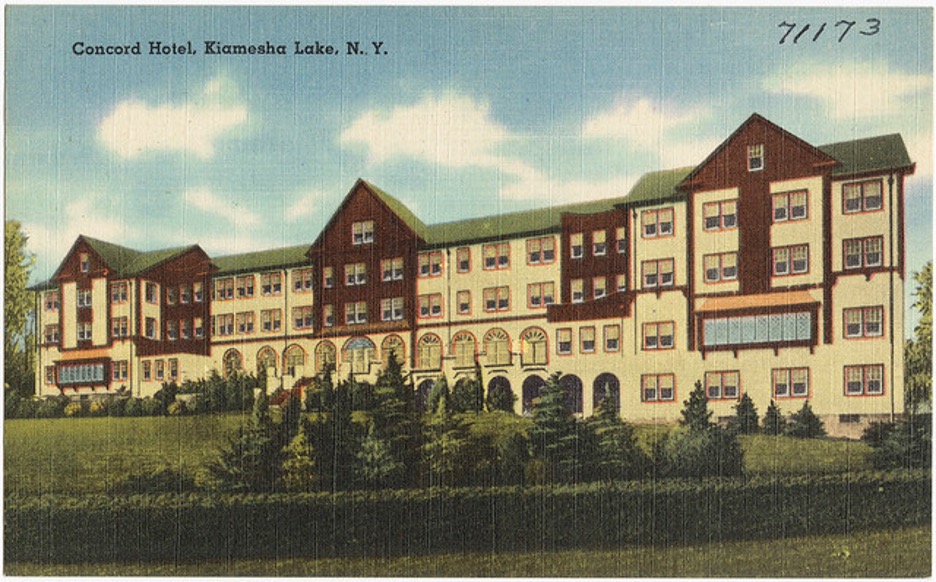
An old postcard of the Concord Hotel. From Fliker.

Resorts like the Concord Hotel built a niche market that helped them prosper in the 1950s and 1960s. As Bernie Weichel recently wrote in Skiing History, the Catskills in the 1950s were known as the Borscht Belt, the Jewish Alps, and, by some, the Sour Cream Sierras. Famous winter resort towns like Lake Placid, Stowe, and Mont Tremblant often had Jewish-centered hotels. But anti-Semitism was rampant. The Lake Placid Club was renowned for its white supremacy. It defended its exclusion of BIPOC and Jewish patrons in closely watched court cases well into the 1960s. But in the 1950s, for example, as many as 80% of hotels, boarding houses, and rooms for rent in Stowe, Vermont did not welcome Jewish skiers. In other words, Lake Placid was representative of ski towns throughout the East. Patrons could navigate these waters by carefully reading ads. For instance, the word “restricted” advised Black and Jewish skiers that they were unwelcome. In contrast, phrases such as “observing strict dietary rules” or “Jewish-American cuisine,” notified people that the hotels served kosher meals, and were presumably Jewish-owned and operated. Nevertheless, vacationing in generally hostile towns was not particularly appealing. Jewish-owned ski centers and hotels in the Borscht Belt allowed the rapidly growing Jewish middle- and upper-middle-class population of New York and Philadelphia to ski in safety and comfort. But, places like the Concord still had to convince Jewish patrons to ski. The problem was that the Catskills were cold. But, compared to their northern cousins, the mountains were not particularly snowy. Convincing people to vacation in an often brown, damp, and dreary location was difficult.

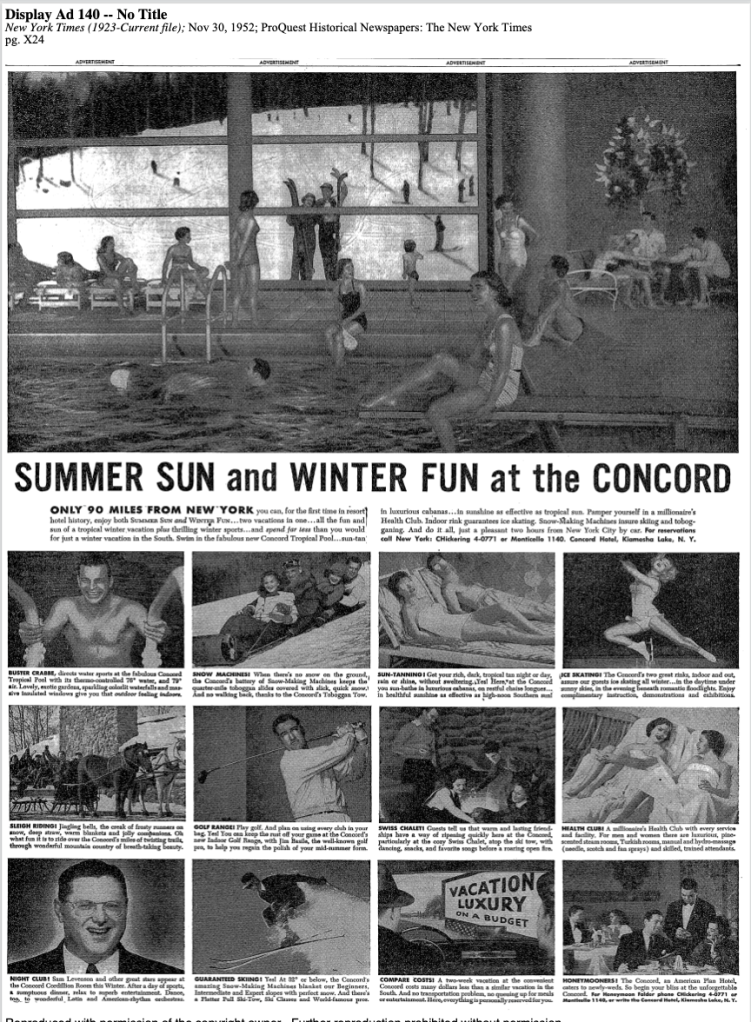
On January 6, 1952, the Concord published for the first time a half-page ad titled “Summer Sun and Winter Fun.” Printed in The New York Times, The Philadelphia Inquirer, and other regional papers, their ads dwarfed those of other winter vacation spots. The Concord Hotel was a resort – just not a ski resort. Ski resorts, at least as we known them today, did not yet exist. In the 1950s, they were simply called ski centers. Until the 1950s, the Concord catered mostly to summer guests. It advertised its pool, its tanning beds, entertainment, and the bar and restaurant. Even in the winter, skiing was just one of many winter activities such as tobogganing and skating.

Only 90 miles from New York City, the hotel was a short and easy drive from the metropolis. But, unlike the towns of Lake Placid and Stowe, Kiamesha Lake was small and summer-oriented. And unlike Mount Mansfield and Mont Tremblant, the Concord only boasted a few short slopes and a single rope tow. But the Concord was unique in the 1950s. Their advertising campaign tapped into an idea that was increasingly attractive in the post-war period. They claimed that they could artificially create the weather. They could make snow outside and they could guarantee a tropical setting inside.

This was printed over and over in The New York Times. Some dates include Jan. 6, 1952; Jan. 13, 1952; Jan. 20, 1952; Jan 27, 1952; Feb. 3, 1952; Feb. 17, 1952; Feb. 24, 1952; Mar. 2, 1952; Mar. 9, 1952; and, Mar. 16, 1952. They updated their ads every season, but they remained largely the same throughout the decade.

The Concord ad “guarantees snow” for both skiing and tobogganing. It claimed that “even when nature fails… our revolutionary, new Snow-Making Machine blankets the ski trails with fresh snow, at 32° below.”­ And their snowmaking system truly was revolutionary. In 1952, they were one of only three resorts in the country with snowmaking machines. (For more on the early history of snowmaking see my article “Chilling the Industry.”)


This ad from Mirror Lake Inn was the second I have found to mention snowmaking. The small size compared to the Concord is notable. That said, being in Lake Placid, Mirror Lake Inn was likely known for its winter sports. The New York Times, Dec. 14, 1952

Along with guaranteed snow, the Concord boasted “two magnificent rinks” for skating – one “artificial” and one “natural.” Between tobogganing, skiing, and skating, outdoor enthusiasts could enjoy all aspects of winter recreation. But the Concord also sold summer in the winter. The advertisements boasted that the vacationer could “swim in the new fabulous Concord Tropical Pool… sun-bathe in luxurious native cabanas… in tropical-like sunshine as effective as the southern sun.” As the rime said, “SUMMER SUN and WINTER FUN… two vacations in one!” With our 21st century eyes, the ad may look a bit silly. Both snowmaking and indoor tropical pools lack the authenticity that vacationers often look for today. Historian Hal Rothman has written about this as the post-modern desire for experience. But, at the time, this mechanistic control of environments was highly appealing.

The press took notice of the Concord’s new spin on skiing. For instance, in the fall of 1953, The Philadelphia Inquirer wrote that “it is no longer necessary to head for the north for skiing and skating, or to go south for tanning and tropical swimming. The Concord Hotel … now combines ‘summer sun and winter fun’ thanks to a unique array of sports and recreation facilities.” If the day was cold and dreary, vacationists could stay inside and enjoy the pool. If it was sunny out, the artificial snow guaranteed skiing, even if snow had melted from nearby slopes. The hotel guaranteed an enjoyable day, regardless of the actual weather.

The Concord may have been the first. But it was far from alone in its promise that it could control the weather, creating snow and sun. In the next decade or so, the hotel was joined by any number of smaller, often cheaper, resorts in the Catskills, Shawangunks, and Poconos. By the early 1960s, even large and famous resorts like Mount Snow, in the rugged and snowy Green Mountain National Forest of Vermont, adopted the Concord’s idea of mixing the summer and the winter. It, like its more southern competition, boasted a large snowmaking system and a tropical pool that looked out onto the ski slopes. Walter Schoenecht is often given credit for this as his innovation. And his resort was undoubtedly unique in its commitment to creating a hog-podge resort that offered an array of attractions. Nevertheless, this innovative scheme originated in large part due to the exclusion of the Jewish bourgeoisie from more famous “restricted” resorts and towns. And it suggests the overlooked importance of the small Catskill Mountains in the development of skiing.


Skiing in Moccasins

I was sitting in the Tread of the Pioneer Museum in Steamboat Springs. After almost a year of researching exclusively online, I was in a room. And I had a beautiful thing – subject files. The problem with researching online is the inevitable reliance on key words. Searching through the New York Times, Ski Magazine, or Outside, I get articles on exactly what I am looking for, but little else. But subject files determine the key words for you. Skiing, ski equipment, ski technology, steamboat springs, rout county.

I found myself looking through the ski equipment folder. I often avoid articles on equipment. I personally find the subject somewhat tedious. But, without files on my usual online search terms – snow making, avalanches, ski resort – I was forced to look through what was available. I was surprised by what I found.

Looking through about 20 to 30 clippings and booklets from about 1900 on, a contiguous thread began to emerge. There is a tried and true story about ski equipment. Skis, bindings, and boots, a trio that is thousands of years old. And, they remained almost unchanged for thousands of years. However, in the mid-1800s, Norwegians – rather than their norther neighbors – began to avidly ski. And in Telemark, a new binding was born. From there boots, skis, and bindings are said to have remained the same. At least until after World War II. It is then that modern ski equipment emerges.

I knew this story. And it is the reason I often avoid articles on the subject. But I noticed a common typology used to describe old ski boots. Frequently, the original boots were described as moccasin-like or having moccasin soles.

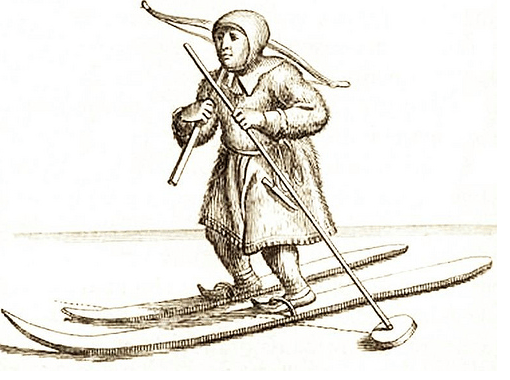
In this depiction, you can see the hooked leather toe of the Sámi boot, as well as the traditional usage of two different sized skis. The hooked toe is thought to be the influence for the pointed toes that Santa’s elves wear.

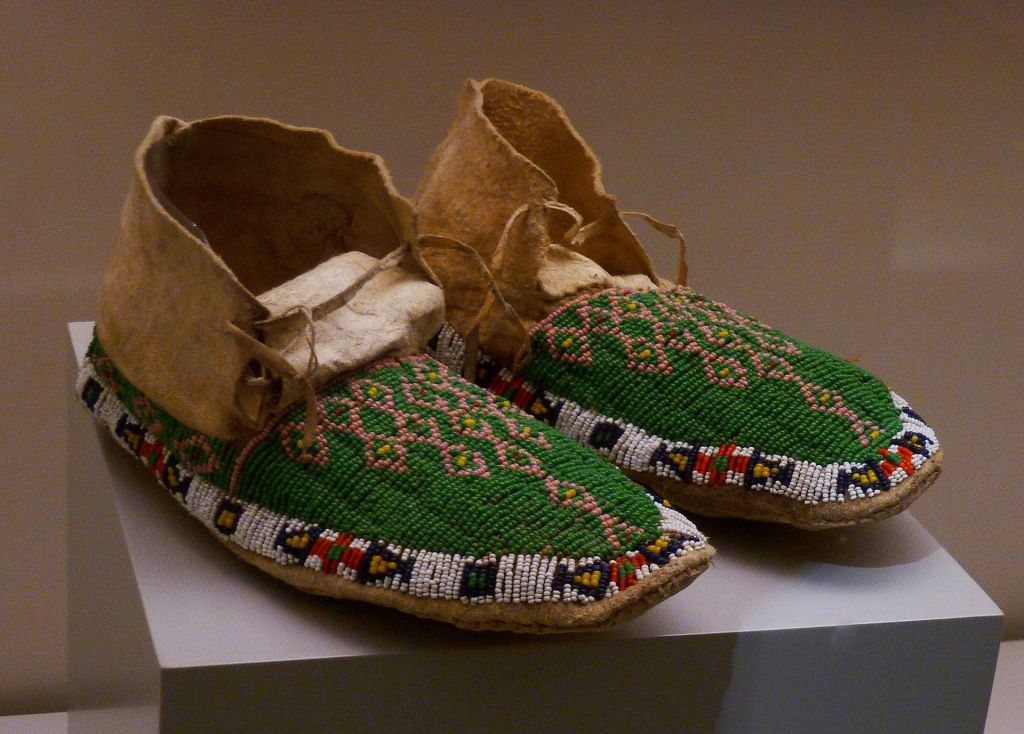
The description first caught my eye in a 1977 article in Colorado magazine. Evelyn DiSante wrote that at the beginning of World War II “skiing was a primitive sport – the most modern equipment consisting of wooden skis… ‘bear-trap’ bindings and moccasin-like ski boots” (italics my own). The article itself was on World War II and skiing. So, it was unsurprising that she marked the war as the key turning point in ski equipment. But I did find the description of the boots as moccasins interesting. After all, Native Americans did not traditionally ski. In other words, moccasins were never used for skiing.

Describing things as moccasins is not in of itself shocking. For north American audiences, the footwear evokes an easily recognizable style and material. In terms of prose, it is neat and short. A single word stands in for a long description of soft, tanned, and decorated leather. And in only one instance it seems like a useful analogy. But the term reappeared as I continued through the folder.

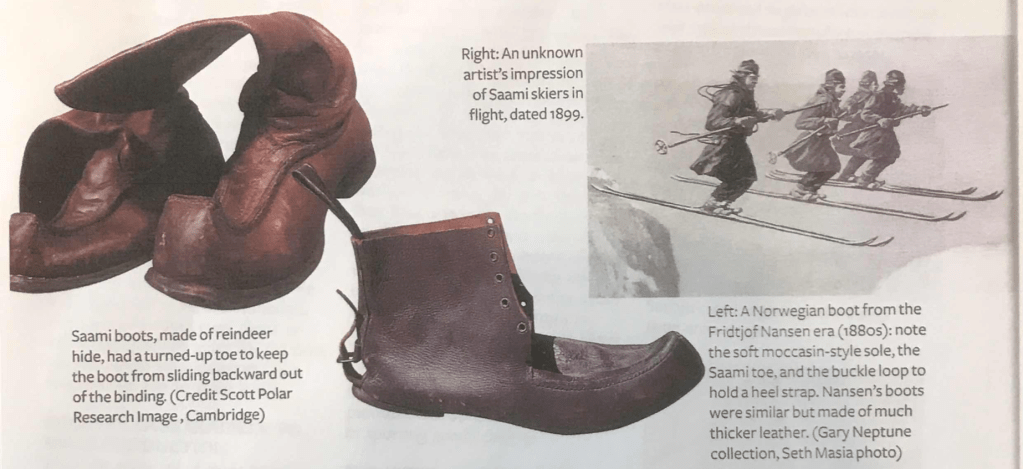
A 2006 article from Skiing History described early boots with the same word. DiSante had used an Algonquin word – moccasin –  to describe a Sámi technology. The more recent author chose to simultaneously reference the Sámi from northern Scandinavian and Native Americans from Turtle Island (North America), to describe an early boot. Under an image, the caption read, “note the soft moccasin-style sole, the Saami toe, and the buckle loop to hold the heel strap.” Moccasin this time was highly specific. It referred specifically to the sole of the boot. The boot tips, in turn, was referred to as “Sámi.” Neither, in this example, require adjectives connoting Indigenous groups. Rather, the two words convey something more than boot material and design. The words in this context are meant to connote the idea that early ski technology was primitive.

In a Denver Post Magazine article from 1983, J.L. wrote that “until technology improved upon the basic sliding sticks idea, skiing remained primarily a mode of transportation for hunters, woodsmen, doctors, midwives, priests, undertakers, and postmen.” The author started thousands of years in the past. The implication is that until World War II skiing technology was primitive. Implicitly this suggests that ski equipment has continued largely unchanged over all that time.

According to these two articles – as well as a number of reputable histories of skiing – there is a moment in which the rudimentary action of sliding downhill transformed into a modern sport. By and large, this is considered a good thing, or at times even an accomplishment. There are at least two assumptions behind the idea of skiing’s progress. Assumption 1, skiing as a sport should be celebrated for bringing an old technology into modern European culture, broadly understood. But skiing did not have to evolve that way. And not everyone necessarily saw this new sport as necessarily good. In the late 19th and early 20th centuries Sámi in Scandinavia were still using skis as an essential mode of transportation. For them, the skisport likely ranked far below transportation. Assumption 2, early technology was primitive. Today’s technology is modern. Usually, either the telemark binding in the 19th century, the first metal bindings in the early 20th century, or the end of World War II mark the most important turning point.

Cheyenne Moccasins from the Museum of the Americas in Madrid.

In order to quickly demonstrate the primitive nature of early ski boots, commentators used the adjectives moccasin and Sámi to denote the idea of primitiveness. A hooked tow or a soft sole lacked the deeper meaning of these articles’ arguments. Rather, invoking Indigenous people and Indigenous shoes suggests a pre-modern state, a moment that an imagined “we” have left and which we do not hope to return to.

Instead, the descriptors are used to evaluate the value of old ski boots. Both words suggest a primitive past, despite the continued use of both styles of footwear today. In turn, the uniqueness of Indigenous or Native identities on opposite sides of the ocean were collapsed in favor of one overarching idea of a premodern past. The imagery of Indigenous footwear provided the subtext for just how non-modern (and so of limited use) old ski boots were compared to their plastic cousins.

Although rarely viewed this way, skiing in the United States is a moment of double-appropriation. Skiing is often described as Norwegian in origin. But it is really Sámi. (When reading early English language texts on skiing, the Sámi are called “Laplanders,” a term no longer used.) The Sámi historically inhabited the northern portions of Scandinavia. However, their largely nomadic lifestyle – along with their language, clothing, and other parts of their culture – came under fire as powerful and militarized nation states emerged in the region. In the 19th century Russia, Sweden, and Norway attempted to build nationalist cultures that mirrored France, Germany, and Britain. This process required the cultural unification of their respective countries. To accomplish this goal, the Norwegian government forced Sámi peoiple to integrate with nationalist cultures. This was done through the enforcement of boarders, mandatory Christianizing schools, and through an attempt to (in the eyes of the Norwegian state) modernize Sámi culture. (A very similar process occurred in the United States through state-sponsored Native American boarding schools and through the Dawes Act among other things.)

While nations overlay and disguise geographical, ethnic, racial, and cultural differences, they frequently adopt pieces of the Indigenous cultures they tried to erase. In the United States, we see this through the use of Native American imagery. Western ski resorts are complicit in this, with some like Steamboat and Jackson celebrating their frontier pasts. However, at times the appropriation of Indigenous cultures is more quotidian. For instance, Americans regularly wear moccasins as slippers. And, of course, it is from this appropriation that the term “moccasin-like” derives its significance in the articles described above. Though not a perfect analogy, much as Americans adopted moccasins, Norwegians adopted skiing. Under Norwegian influences, skiing rapidly turned from a tool for transportation and herding into a sport. This was the original appropriation of skiing.

Snowshoe Thompson

In time, skiing was brought to the United States for the first time in the mid-19th century by Scandinavians indoctrinated in new nationalist discourses. Despite how primitive the technology supposedly was, skis played an essential role in the colonization of the Rocky Mountains and the Sierra Nevadas. Using skis postmen and priests floated over snow, while trains got stuck in the winter weather. As a result, skis kept mining towns connected to other settlements in areas. There is an irony here. Although this technology was deemed primitive, the Indigenous (to Scandinavia) ski proved more valuable to settlers in the winter than the metal, mechanical technologies celebrated at the time as the height of modernity.  Nevertheless, without skis, mining the western mountain ranges would have proven far more difficult. Without appropriating this Sámi technology from Norwegian immigrants, the removal of various tribes – and their forced integration through reservations and schools – could have slowed or stopped settler colonialism in the region. As a result, we see the second moment of appropriation of skiing. The appropriation of skiing by Americans from Norwegians.

In the U.S., Scandinavian Indigeneity does not seem to sufficiently demonstrate the idea that skis, until World War II, were primitive. Instead, Sámi must be helped or replaced by an (equally false) Americanized image of Native American primitiveness. There is little appreciation and knowledge within the United States of Sámi people. So, the use of their name to demonstrate primitiveness could be read as accidental. But I don’t think it is. The use of the term moccasin to demonstrate the apparent primitiveness of the boot is easily understood by Americans. And the combination of a “moccasin” sole and a “Sámi” toe links the two together into a single – and geographically impossible – example of a distant past.

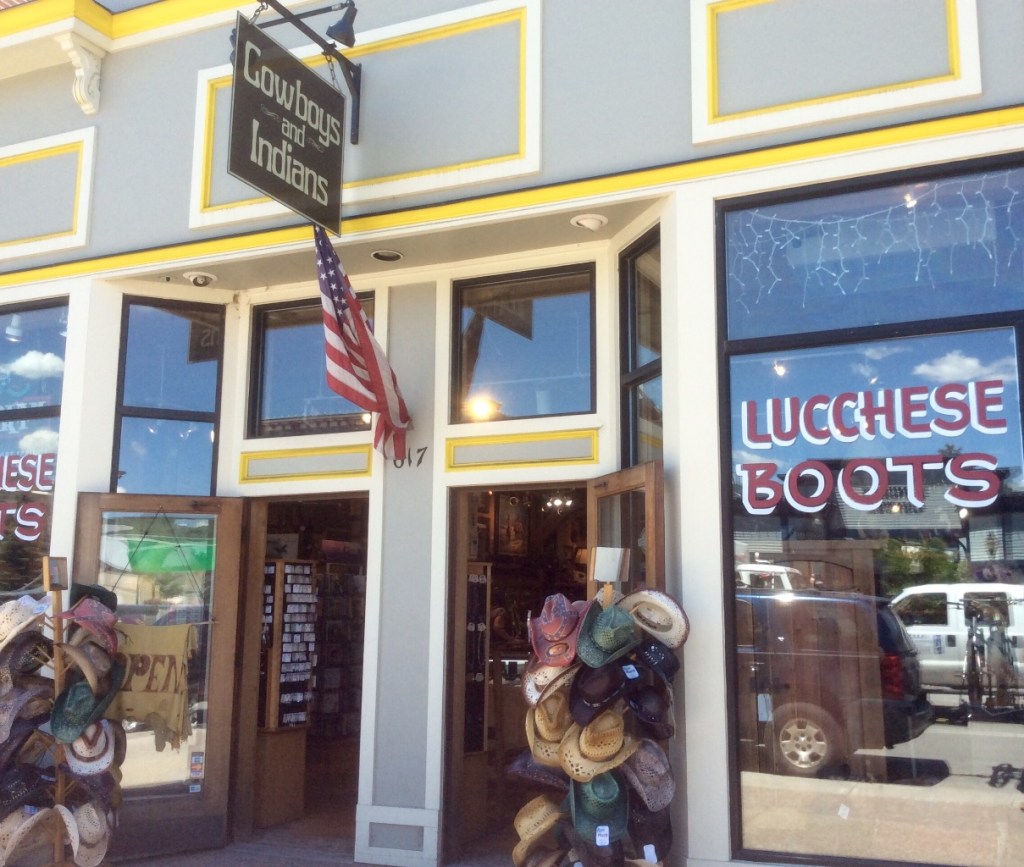
These descriptions of technology, mirror the sale of Native American imagery at western ski resorts. Stores with Native Americans in headdresses (or in some places the stylized selling of head dresses) are commonplace in ski towns. For example, after leaving the museum in Steamboat, I walked through town, attempting to get a sense of the atmosphere. Three of the most prominent stores referenced Cowboys and/or Indians. Much like ski boot descriptions, these stores universalized distinct Indigenous peoples and cultures. For instance, at the end of downtown, with the ski mountain in the background, was a store named Cowboys and Indians. As I entered the store, I was invited into a world of leather. And the ambiance was overwhelmingly western. While the left side of the store was predominately Cowboy themed, the right side was dedicated to Native American artisanal works. The interesting part, however, was that almost all the Native American works were created by Indigenous people in Mexico – not by Native Americans, a term usually reserved for people Indigenous to what is now the United States. There is nothing wrong with selling Indigenous made wares, provided they are truly made by Indigenous people. But like the articles about ski boots, the store flattened Indigenous heterogeneity into a homogenous past. And in both instances, white American skiers get to place themselves as moderns next to real and continuing cultures that are deemed primitive.